

How to read a Destiny Matrix chart

Most guides hand you a list of positions and leave you to work out what to do with them. This one gives you the order to read them in, then reads a complete chart from one birth date, position by position, to the end.
That last part is the difference. A list of what each position covers is easy to find. Watching someone actually read a chart — including where two positions contradict each other and what to do about that — is not.
The Short Answer Read from the centre outwards
Start with the centre, the comfort zone and the strongest influence in the chart. Then the four diamond corners: portrait at the left, gifts at the top, material life at the right, karma at the bottom. Then the outer square, which carries the ancestral lines. Read the specific channels — money, love, talents — last, because they only make sense against the centre.
✦ The meaning is never in one number. It is in how the positions sit against each other.
The shape of the chart
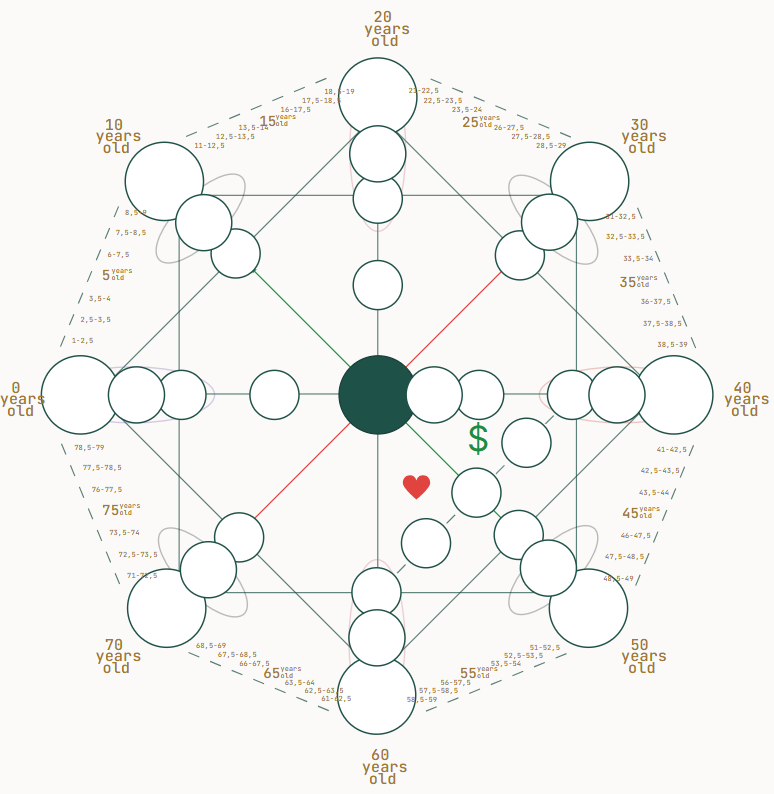
A Destiny Matrix chart is an eight-pointed diagram built from your date of birth, where every position holds a number from 1 to 22 corresponding to one of the 22 arcana.
It is two shapes laid over each other.
The diamond — the one standing on its corner — is personal. Your day sits at the left, your month at the top, your year at the right, and the sum of those three at the bottom. Everything inside the diamond is about you.
The outer square around it is ancestral. Each of its corners is the sum of the two diamond corners beside it, and together they carry what came down your family lines before you were born.
Two axes cross in the middle. The horizontal is the Earth line — body, home, possessions, money, the visible world. The vertical is the Sky line — intuition, memory, inner life, what carried over. Where they meet is the centre, and the centre matters more than anything else on the page.
Building it from a birth date
Nothing here is drawn or guessed. The same date always produces the same numbers, which is why any correctly built chart will match any other.
Reduce the date. Day, month and year each come down to a number between 1 and 22. Anything larger has its digits added again — 25 becomes 2 + 5 = 7. The month is already 1–12, so it never needs reducing.
Fill the diamond. Day at the left, month at the top, year at the right. Add all three for the bottom corner. Add all four for the centre.
Build the outer square. Each corner is the sum of the two diamond corners beside it, reduced the same way. Every remaining point follows the same rule.
Worked example — 7 January 1987
| Position | Working | Number | Arcanum |
|---|---|---|---|
| Day, at the left — portrait | 7 | 7 | The Chariot |
| Month, at the top — gifts | 1 | 1 | The Magician |
| Year, at the right — material life | 1+9+8+7 = 25 → 2+5 | 7 | The Chariot |
| Bottom corner — karma | 7 + 1 + 7 | 15 | The Devil |
| Centre — comfort zone | 7+1+7+15 = 30 → 3+0 | 3 | The Empress |
| Square, upper left | 7 + 1 | 8 | Justice |
| Square, upper right | 1 + 7 | 8 | Justice |
| Square, lower right | 7 + 15 | 22 | The Fool |
| Square, lower left | 15 + 7 | 22 | The Fool |
Hold on to these numbers. Section 11 reads this exact chart from beginning to end.
You do not have to do this by hand. The free Destiny Matrix calculator builds the whole chart from a date of birth and fills in every position this guide covers. No account, no payment step.
The reading order, and why it matters
This is the part almost every guide skips. Positions are not equal, and reading them in the wrong order produces a list of adjectives rather than a picture of a person.
| Position | Working | Number |
|---|---|---|
| First | The centre | The strongest influence. Everything else gets read against it. |
| Second | The four diamond corners | The frame of the personal chart: how you appear, what you were given, what you build, what you owe. |
| Third | The outer square | The family programmes running underneath. Explains a lot of what the diamond only hints at. |
| Fourth | The karmic tail | The pattern that repeats. Read against the centre, never on its own. |
| Last | Money, love, talents | Specific channels. The most interesting, and the least meaningful in isolation. |
If you are using the calculator, the chart is interactive. Tap any area name and that position lights up on the diagram, so you can see which point is being discussed. Tap Read and the interpretation opens on the same card. The areas are grouped in the order above — Centre, then You, Gifts, Money, Love, Family lines, and Karma last.
Centre — the comfort zone
“What do I return to when nothing is asked of me?”
The centre is where you go back to. It is the state you default to when the performance stops, and equally the state that takes over when life presses hard enough that you stop choosing.
It has two faces. In a positive state it is where you draw strength: the version of you that feels effortless and recognisable. In a negative state it becomes the thing you cling to past its usefulness — the same energy, dug in.
Read this before anything else. Two people can share an identical karmic tail and read completely differently because their centres differ.
You — how you appear, and where you came from
Portrait & Personality
“What do I return to when nothing is asked of me?”
The portrait is a mask, and that is not a criticism — everyone wears one. It is the impression you make in a room before anyone has heard your story: what people assume about you, what they hand you responsibility for, what they brace against.
It is often the position people recognise fastest in their own chart, because other people have been describing it to them for years.
This is not the centre. A great many sites merge the two, which is why charts appear to contradict each other. The portrait is the left corner. The centre is the centre.
Parent–Child Balance
“What do I return to when nothing is asked of me?”
This position holds the charge — the grievance that has not been named, the insult that still sits in the body, the thing you would say if the conversation were safe. It reads along both lines, so it separates what belongs to the masculine side from what belongs to the feminine side.
It is often uncomfortable, and it is also usually the position people report as the most useful.
Parenting Patterns
“What am I passing forward without deciding to?”
The same channel read forwards instead of backwards. What you give your children, what you repeat from your own upbringing without choosing it, and what can stop with you if you see it clearly enough.
Gifts — what you were given
Talents & Potentials
“What came free, before anyone taught me?”
Three separate streams, and it is worth reading them separately:
- From above — the abilities that arrived as a bonus rather than an earning. Often the ones you undervalue precisely because they cost you nothing.
- Through the mother line — what the women before you carried and handed forward.
- Through the father line — the same, on the other side.
Where the same arcanum appears in two streams, that talent is doubled and usually obvious. Where a stream sits empty of anything you recognise, that is a gift not yet picked up.
Heart’s Desire
“What does this chart actually want, underneath what it has been trained to pursue?”
Less a position than a steer: where to lean, what to stop feeding, what to try next. It is the plainest-language part of the chart and often the one people act on first.
Money — five different questions
Money is not one position. It is five, and they answer genuinely different questions. Reading them as a group is where the picture appears.
Abundance Block — what keeps stopping it?
Eight scripts that can run a life on autopilot: talking yourself down, the overdo loop, staying too comfortable, going quiet. Each has a gift buried in it, a trap, and a specific way through. Most people recognise one immediately and argue with the second.
Past-Life Money Attitude — where did my beliefs about wealth come from?
An attitude toward money that did not start with this paycheck. Usually inherited, usually unexamined, and usually still running the room.
Past-Life Money Attitude — where did my beliefs about wealth come from?
An attitude toward money that did not start with this paycheck. Usually inherited, usually unexamined, and usually still running the room.
Relationship & Money Channel — what happens to money when another person is involved?
The bridge where intimacy and resources meet: who pays, who holds, who freezes, and where the balance point sits. Read this against the love positions below. It is where the two halves of most people’s difficulties actually join.
Love — the pattern, not the wishlist
Ideal Partner
“Who do I keep recognising?”
Not a wishlist. This is the pattern you fall for on sight — what feels like home in another person, and where you keep choosing the near-miss version of it.
Read against the centre. When the ideal partner and the comfort zone want opposite things, that tension is usually the whole story of someone’s relationship history.
Sexuality & Attraction
“How does attraction move through this chart?”
Presence, heat, and the way you meet intimacy — how you signal interest, what draws people in, and where you close down.
Family lines — the square around everything
Five positions on the outer square. This is the layer most people skip and most readers consider the important one, because it explains why the personal chart behaves the way it does.
Male Ancestral Line — what travels down through the men before me?
Drive, distance, authority, and the gift underneath them. This position also describes how you meet masculine energy generally: fathers, brothers, bosses, and the masculine in yourself, whatever your own gender.
Female Ancestral Line — what travels down through the women before me?
Care, silence, gift, and unfinished business. The same reading on the opposite diagonal: mothers, sisters, partners, and the feminine in yourself.
Male & Female Ancestral Karma — what is the programme, and what is the talent inside it?
Each line carries a spiritual current and a material one. The programme is what repeats; the talent is what the programme was protecting. They are almost always the same energy read two ways.
Family & Ancestral Power — what can I draw on when my own resources run out?
The family force behind you: inherited talent, the duty that comes attached, and the weight that is not only yours to carry. Read it as a resource rather than a burden and it changes shape
More on family power
“What pattern did I arrive with unfinished?”
Three numbers, written as a sequence such as 12-16-4. There are twenty-six documented combinations, and each describes a pattern that shows up early and keeps repeating until it is handled directly rather than avoided.
Read it in three passes: Each number in its own right. Then the first two as cause and effect. Then all three as one programme.
If you have seen your tail written the other way round — 4-16-12 rather than 12-16-4 — it is usually the same three energies. Some readers list them from the bottom point upward.
The tail is always given in its difficult state. That is the point of it: it is the debt, not the gift.
A complete chart, read start to finish
Everything above tells you what each position covers. This section does the thing the rest of the internet leaves out: it takes one chart and reads it through, in order, including the places where two positions disagree.
The chart is 7 January 1987, built in section 2:
Centre 3 · Portrait 7 · Gifts 1 · Material 7 · Karmic corner 15
Outer square 8 · 8 · 22 · 22
First: the centre — 3 (The Empress)
The Empress defaults to nurture, beauty, and sensual sovereignty. When life pressures recede, this person does not crave solitude or intellectual analysis; they desire comfort, sensory order, and the ability to cultivate their immediate surroundings into a fertile sanctuary.
In its positive expression, the 3 centre provides an effortless warmth that disarms strangers and naturally attracts resources. When negatively manifested or cornered, Empress energy slips into territorial control, material anxiety, vanity, and overbearing maternal surveillance.
Second: the portrait — 7, against a centre of 3
Here is the first thing worth noticing, and it needs no interpretation to see: the portrait and the centre are different numbers, and they are not related by arithmetic. This person shows a 7 and returns to a 3.
Arcanum 7 (The Chariot) appears outwardly as a hyper-focused conqueror, driven by velocity, milestones, and strategic victory. Observers perceive an assertive commander with rigid discipline. Yet internally, the 3 Empress wants relaxation, warmth, and unhurried ease. The tension is palpable: people constantly hand this person the driver’s wheel, expecting tireless momentum, while their core identity exhausts itself maintaining that armour.
Third: the karmic corner — 15, against a centre of 3
This is the comparison that matters most in any chart, and this one is unusually legible. The karmic corner is 15, the Devil — the arcanum of attachment and appetite. The centre is 3, the Empress — abundance and provision.
Those two are close relatives. Attachment and abundance are the same impulse at different pressures.
Those two are close relatives. Attachment and abundance are the same impulse at different pressures.
That closeness is the point. When the centre feeds the karmic pattern rather than resisting it, the pattern does not feel like a problem. It feels like personality, and it can run for decades unquestioned. Compare a chart where the centre and karmic corner pull in opposite directions: that person feels friction early, dislikes it, and usually deals with it sooner.
Arcanum 15 in karma indicates past-life debt around addiction, power plays, manipulation, or excessive reliance on sensual indulgence. Because Empress 3 also loves pleasure and luxurious ease, this individual rarely recognises their shadow appetites as toxic — rationalising indulgence as merely “enjoying life” until boundaries collapse.
Fourth: the material corner — 7, doubled with the portrait
The day and the year both reduce to 7. That is not a coincidence to interpret away — it is an emphasis. The same arcanum sitting in two corners of the diamond means that energy is doing work across unrelated areas of this life.
With 7 operating at both the social entrance (Day) and the wealth gate (Year), career and financial breakthrough demand movement, vehicle mobility, independent initiative, and clear mission goals. The pitfall is chronic restlessness: believing that whenever stagnation occurs, one must abandon the project rather than sit through the stillness.
Fifth: the gifts corner — 1 (The Magician)
Arcanum 1 in the month position grants instant thought-manifestation, linguistic persuasion, and executive self-reliance. This person was born with an innate ability to initiate reality from pure will. The warning: Magicians must work with peers rather than viewing everyone as assistants.
Sixth: the outer square — 8, 8, 22, 22
The ancestral layer here has an unusual shape: two pairs, not four separate numbers. Justice twice along the top, the Fool twice along the bottom.
The ancestral layer here has an unusual shape: two pairs, not four separate numbers. Justice twice along the top, the Fool twice along the bottom.
Doubled 8 (Justice) along the paternal and maternal upper line signifies deep lineage preoccupation with legal fairness, family reputation, cause-and-effect, and ancestral guilt. Doubled 22 (The Fool) at the base demands complete spiritual liberation — dissolving lineage cages and daring to start afresh with zero baggage.
Reading the whole thing
The through-line begins at an Empress (3) core who wants creation, comfort, and fertility, but armours herself in a Chariot (7) shell of speed and control to protect against the shadow of Devil (15) attachments. The ancestral lines provide strict Justice (8) accountability above, counterbalanced by a desperate evolutionary demand from the ancestors below to achieve absolute Fool (22) spiritual freedom.
The single most useful action for this chart: Stop using busyness and professional conquest (7) to numb emotional and sensual appetite (15), and let your Empress (3) build tangible sanctuary through pure Magician (1) intentional creation.
Reading positions together
A number is a character. A position is a stage. The same arcanum plays completely differently depending on where it stands.
Arcanum 4 in the money line describes how you organise resources — structure, ownership, control. The same arcanum in the love line describes how you organise a relationship. Very different sentences about the same person.
Four pairs worth comparing
| Compare | What it tells you |
|---|---|
| Centre ↔ karmic corner | Whether your default state feeds the pattern or resists it. The single most useful comparison in the chart. |
| Love line ↔ money channel | Whether intimacy and resources pull the same direction. When they do not, one is usually being sacrificed for the other. |
| Male line ↔ female line | Which inheritance is louder, and which one you have unconsciously been taking sides with. |
| Portrait ↔ centre | The distance between how you appear and who you are. A wide gap is exhausting to maintain, and usually explains why. |
Watch for repeats
When the same number appears in three or four positions, that energy is the theme of the whole chart. It is not a reason to read the same paragraph four times — it is an emphasis, and it means that arcanum is doing work across unrelated areas of life.
Five mistakes people make
1. Reading the portrait as the centre
The most common one, and the reason two charts of the same person can look like they disagree. Portrait is the left corner. Centre is the centre.
2. Reading positions in isolation
A single number tells you almost nothing. The chart is a set of relationships, and any position read alone will sound either flattering or alarming — neither of which is accurate.
3. Treating the karmic tail as a prophecy
It describes a pattern, not a fate. It is given in its difficult state deliberately, because the difficult state is the part that repeats. Recognising it is most of the work.
4. Expecting a prediction
The Destiny Matrix does not forecast events. It will not tell you when you will meet someone or whether a job will work out. It describes what you are working with. Anyone selling it as prediction is misrepresenting it.
5. Assuming everyone numbers the arcana the same way
They do not. Rider–Waite tarot swapped Strength and Justice, so some sites show 8 as Strength and 11 as Justice. The older Marseille order — the one the Destiny Matrix sources follow — has 8 as Justice and 11 as Strength. If a chart elsewhere looked wrong, this is usually why.