

Destiny Matrix Power of Family — All 22 Meanings Explained

There’s a position on your Destiny Matrix Chart that doesn’t get talked about as much as the Karmic Tail or Love Line, but once people understand it, they often say it explains more about their family than years of trying to figure it out in conversation. It’s called the Power of Family — sometimes referred to as the Ancestral Square — and it sits at the very centre hub of your chart.
This guide explains what it means, how to find your number, and what each of the 22 possible meanings reveals about the patterns running through your family line.
What This Position Actually Describes
The Power of Family sits at the central hub of your octagram — the point where the chart’s main lines converge. A few things make this position distinct from other family-related sections of your chart:
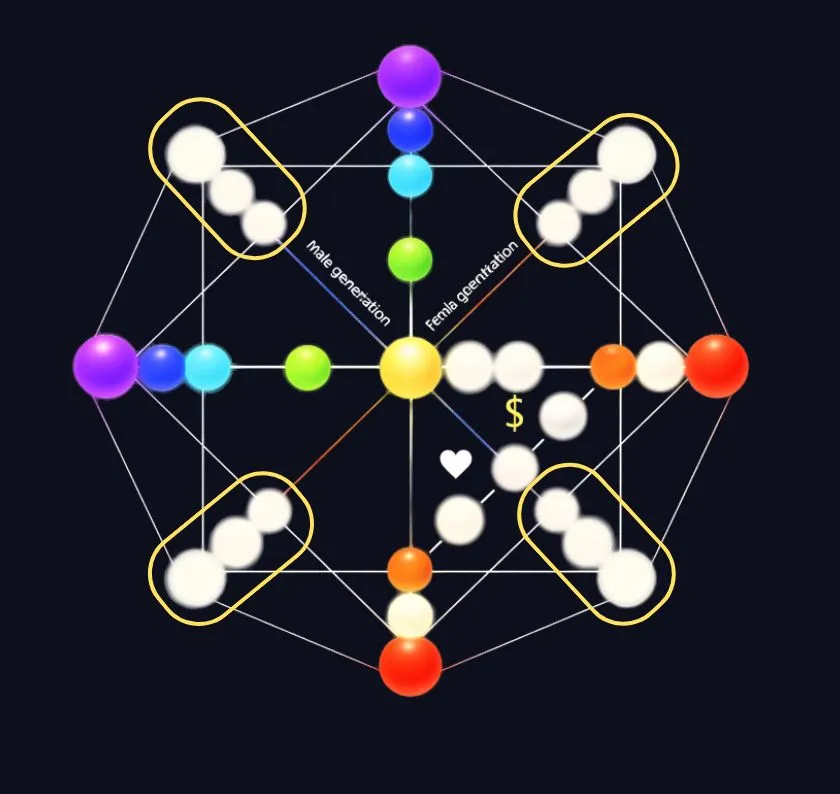
No split by side. Unlike your Paternal Line and Maternal Line — which are calculated separately and describe what came specifically through your father’s side versus your mother’s side — the Power of Family blends both lines together. It’s the shared field you were born into, not a father’s-side or mother’s-side reading.
Not fate — a pattern. This number doesn’t describe something fixed or unchangeable. Think of it as a default setting. You can amplify the parts that serve you, and you can consciously work on rewriting the parts that don’t.
Best used with action. Reading the description is useful, but the actual shift happens through practice — small, repeated changes in how you respond, set boundaries, or make decisions. Every meaning below includes a specific action for exactly this reason.
Some practitioners describe the Power of Family as becoming most relevant from around age 40 onward — the period when ancestral patterns tend to surface more visibly. That said, if you’re noticing inherited patterns earlier than that, this section is still worth reading at any age.
How to Find Your Number
This takes about two minutes if you have your chart open.
- Generate your Destiny Matrixhttps://destinymatrixchart.com/ Chart using your date of birth — the free calculator requires no signup
- In the readout, locate the position labelled “Power of Family” (sometimes shown as “Family” or “Ancestors”) at the centre hub of the octagram
- Note the number — it will be between 1 and 22. That’s the section to read below
What Each Meaning Includes
Every number below follows the same four-part structure:
- Core Pattern — what tends to run in the family line
- Inherited Gifts — what you do well by default, without having to learn it
- Watch-outs — where this pattern can become limiting if left unchecked
- Try This — one specific, small action to start shifting the energy
All 22 Power of Family Meanings
1 — The Maker
Core Pattern: Families that solved problems through ingenuity and grit — the kind of household where someone always found a way, even with limited resources.
Inherited Gifts: Creativity under pressure, initiative, a natural DIY mindset. You probably don’t think of “figuring it out yourself” as a skill — it’s just how you operate.
Watch-outs: Going it alone. Fixing everything yourself, even when help is available and would actually be faster.
Try This: Before you jump in to solve something, ask yourself: “Who could co-create this with me?” Keep a simple “solutions log” — a running list of problems you’ve already solved — and look back at it when you need a reminder that you’ve done this before, instead of immediately chasing the next fix.
2 — The Listener
Core Pattern: Quiet wisdom, spiritual learning, families who kept traditions and passed down knowledge through listening rather than lecturing.
Inherited Gifts: Intuition, emotional attunement, a calming presence that other people notice even if you don’t.
Watch-outs: Over-absorbing other people’s emotions. Avoiding conflict to the point that things go unresolved.
Try This: Start a small ritual — two minutes of slow breathing before you make a decision, especially an emotional one. When journaling, separate two columns: what you feel versus what you know as fact. Decide using both, not just one.
3 — The Nurturer
Core Pattern: Strong maternal lines where caregiving was the centre of family power — the person who held everyone together through care.
Inherited Gifts: Warmth, empathy, a natural ability to create beauty and safety in a space.
Watch-outs: Overgiving. Feeling responsible for everyone else’s mood, to the point of losing track of your own.
Try This: Practice the sentence: “I care — and here’s my boundary.” Both halves matter. Try scheduling your own joy first in the week, before everyone else’s needs fill the calendar — generosity holds up much better when it isn’t running on empty.
4 — The Pillar
Core Pattern: Leadership, order, and discipline — families where someone was always the one who “held it together,” often quietly and without praise.
Inherited Gifts: Structure, reliability, the ability to stay calm and take charge during a crisis.
Watch-outs: Rigidity. Carrying burdens alone because asking for help feels like admitting the structure is cracking. Fear of change, even good change.
Try This: Delegate one task this week — just one. Try framing it as trading 10% control for 90% relief, and notice what actually happens versus what you feared would happen.
5 — The Guide
Core Pattern: Teachers, mentors, or community figures — families with strong values and a clear sense of “how things are done.”
Inherited Gifts: A strong ethical compass, the ability to give clear counsel, and the kind of presence that earns community trust.
Watch-outs: Moralising. Being more focused on being “right” than on being genuinely helpful to the person in front of you.
Try This: Before giving advice, ask: “What outcome do you actually want?” Then tailor what you say to their goal — not to your own rulebook of how things should be done.
6 — The Lover
Core Pattern: Families where relationship choices shaped the larger family story — who married whom, who stayed, who left, often became the defining narrative.
Inherited Gifts: Devotion, strong partnership instincts, a natural capacity for reconciliation after conflict.
Watch-outs: Over-idealising love. Repeating the same triangle dynamics — the same shape of relationship conflict — across different relationships without noticing the pattern repeating.
Try This: Create a simple non-negotiables list for relationships — the things that matter regardless of how strong the initial connection feels. Review that list before saying yes to something significant, not after you’re already invested.
7 — The Victor
Core Pattern: Migration, hardship, obstacles overcome through sheer persistence — families whose story is defined by what they survived and pushed through.
Inherited Gifts: Willpower, endurance, an unusually strong ability to stay focused on a goal even when conditions are difficult.
Watch-outs: Treating life as a constant fight. Only allowing yourself to rest after winning — which can mean never really resting at all.
Try This: Add celebration checkpoints to big goals — at 25%, 50%, and 75% completion, not just at the finish line. This trains your nervous system to register progress itself as safety, not only the final win.
8 — The Advocate
Core Pattern: Justice, fairness, and speaking truth to power — families where someone was always the one willing to push back when something wasn’t right.
Inherited Gifts: Balanced judgement, strong negotiation instincts, the ability to hold clear boundaries.
Watch-outs: Resentment when outcomes don’t feel fair — even when the situation is otherwise resolved.
Try This: Practice separating fairness from closure. You can choose to move on and find closure even in situations where the outcome wasn’t fair — the two don’t have to arrive together.
9 — The Seeker
Core Pattern: Solitude, retreat, inner searching — families with a thread of people who needed time alone to process and understand.
Inherited Gifts: Insight, research ability, genuine spiritual or intellectual depth.
Watch-outs: Isolation. Over-thinking. Disappearing — emotionally or physically — when things get stressful.
Try This: Pair your reflection time with one small outward action each day — a text to a friend, a quick check-in, a single question to someone. Insight tends to land better when it’s shared with at least one other person, even briefly.
10 — The Turner of Wheels
Core Pattern: Big swings of fortune — families who experienced major reinvention after major change, more than once.
Inherited Gifts: Adaptability, good timing, an instinct for spotting openings when they appear.
Watch-outs: Waiting for fate to shift things. Giving up your own agency to “the cycle” instead of acting within it.
Try This: Pick a 90-day experiment that’s fully within your control — something you can start and measure yourself. Let the results, not fate, tell you what’s next.
11 — The Brave Heart
Core Pattern: Courage through trials — families where gentle strength carried people through difficult periods, often quietly.
Inherited Gifts: Resilience, compassion that holds up under stress, the ability to stay soft without becoming fragile.
Watch-outs: Carrying everyone else’s pain. Being the strong one so consistently that you never get support yourself.
Try This: Build a two-person support pact with someone you trust — agree to trade weekly check-ins where you each get to be the one who needs to talk, not just the one who listens.
12 — The Giver
Core Pattern: Sacrifice and long patience — families where someone consistently put their own life on pause to serve something bigger.
Inherited Gifts: Perspective, patience, the ability to reframe difficult situations into something workable.
Watch-outs: Self-neglect. Postponing your own life so consistently that “later” never actually arrives.
Try This: For every “yes” you give to someone else’s request, schedule a matching “yes” to yourself — in time, money, or energy. Generosity holds up best when it scales with self-respect, not instead of it.
13 — The Phoenix
Core Pattern: Loss, endings, and powerful rebirths — families whose story includes at least one dramatic before-and-after.
Inherited Gifts: Reinvention, emotional depth, the ability to turn crisis into clarity.
Watch-outs: Reaching for dramatic resets when a smaller repair would actually do the job.
Try This: Practice small, intentional goodbyes — to habits, clutter, or roles you’ve outgrown — on a monthly basis. This keeps change something you choose, rather than something that happens to you.
14 — The Blender
Core Pattern: Healing and moderation — families known for finding the middle path, the mediators and peacemakers.
Inherited Gifts: Mediation skills, the ability to integrate different perspectives, a natural sense of ritual and process.
Watch-outs: People-pleasing. Diluting your own position so much in the name of harmony that you lose track of what you actually think.
Try This: Name your edges — the things you genuinely won’t blend or compromise on. Harmony works best when it’s built from clearly defined ingredients, not from everything dissolving into everything else.
15 — The Unbinder
Core Pattern: Addiction, taboo, and fear-based control — families with patterns around things that weren’t talked about openly.
Inherited Gifts: A natural capacity for shadow work, truth-telling, and helping things (and people) come into the light.
Watch-outs: Swapping one form of compulsive control for another — work, screens, relationships — without realising the underlying pattern is the same.
Try This: Track the cues that precede a compulsive pattern — the time of day, the place, the feeling beforehand. Replace just the first five minutes with a grounding ritual, so the usual loop doesn’t get the chance to start.
16 — The Rebuilder
Core Pattern: Sudden shocks and old structures collapsing — families who experienced abrupt change and had to rebuild from it.
Inherited Gifts: Radical honesty, the ability to rebuild quickly and adapt to new circumstances without getting stuck.
Watch-outs: Bracing for disaster even when things are stable. Burning bridges faster than necessary because waiting feels riskier than acting.
Try This: Put together a simple “resilience kit” — key contacts, a small cash buffer, copies of important documents. Having this ready tends to quiet the underlying fear of sudden change, even if you never need to use it.
17 — The Light-Keeper
Core Pattern: Hope and renewal after storms — families known for keeping faith and encouragement alive through hard times.
Inherited Gifts: Encouragement, creative renewal, the ability to guide others toward hope without dismissing what they’re going through.
Watch-outs: Bypassing hard feelings with forced positivity — moving to “look on the bright side” before the difficult feeling has actually been acknowledged.
Try This: Pair hope with one grounded, practical step — a budget line, a plan, a phone call. Inspiration plus a concrete next step works better than inspiration alone.
18 — The Dream-Diver
Core Pattern: Deep emotion, intuition, and the unseen — families with a strong undercurrent of feeling that wasn’t always spoken aloud.
Inherited Gifts: Symbolic thinking, empathy, a natural connection to art and the emotional layer beneath situations.
Watch-outs: Fog and mixed signals — particularly anxious thought spirals that tend to show up at night.
Try This: Practice “name it to tame it” — when a feeling arises, label it specifically (“this is anxiety,” “this is disappointment”). Keep facts on a separate mental line from feelings. Naming both reduces the swirl between them.
19 — The Radiant
Core Pattern: Joy that follows effort — families with stories of hard-won successes that were genuinely celebrated.
Inherited Gifts: Confidence, vitality, a natural ability to lead by example rather than by instruction.
Watch-outs: Pressure to always be “on.” Treating moments of struggle as failure rather than as a normal part of the process.
Try This: When you share a win, include the messy parts of the process — not just the outcome. This humanises success, for you and for the people around you, and keeps perfectionism from quietly taking over.
20 — The Awakener
Core Pattern: Honest self-review and fresh starts — families who valued the ability to admit something wasn’t working and change course.
Inherited Gifts: Accountability, a genuine belief in second chances, a strong sense of purpose.
Watch-outs: Living permanently in “redemption mode” — endlessly fixing and improving without ever just living in the present.
Try This: Run a simple quarterly personal review — what to keep, change, stop, and start. Then act on just one of those decisions within 72 hours, so reflection doesn’t stay purely theoretical.
21 — The Completer
Core Pattern: Big cycles reaching completion — families whose stories include goals achieved together, often after a long arc.
Inherited Gifts: A broad perspective, the ability to bring things to genuine closure, a sense of mastery earned over time.
Watch-outs: Exhaustion after finishing something significant — or fear of beginning the next thing, because the last completion took so much out of you.
Try This: After completing something major: celebrate, rest, and then name just the next tiny first step — not the whole next project. Completions work better as launchpads than as full stops.
22 — The Pathfinder
Core Pattern: Bold firsts — families with a history of new countries, new careers, or entirely new ways of living that someone chose to begin.
Inherited Gifts: Originality, courage, a genuine sense of joy in taking risks.
Watch-outs: Restlessness. Leaping into new things without enough grounding underneath you.
Try This: Anchor each leap with three stabilisers — a mentor or trusted advisor, a basic financial plan, and a minimum daily routine you can keep no matter what. Freedom holds up much better with a foundation under it.
How to Work With Your Power of Family
Turn the pattern into practice. Pick one “Try This” action from your number and repeat it daily for two weeks. Insight becomes muscle memory through repetition — reading the description once rarely changes anything on its own.
Name the inheritance. Try completing this sentence: “I come from people who ___. I’m choosing ___.” Putting it into words — even just for yourself — changes how the pattern continues.
Read it alongside your other positions. The Power of Family sits at the centre, but it interacts with everything around it. Reading it alongside your Core Essence or Love Line often reveals how family patterns show up specifically in your relationships, work, or financial habits.
Keep the scope in mind. This is a tool for self-reflection — not a medical, legal, or financial framework. Use it for insight, and make significant decisions with appropriate professional support alongside it.